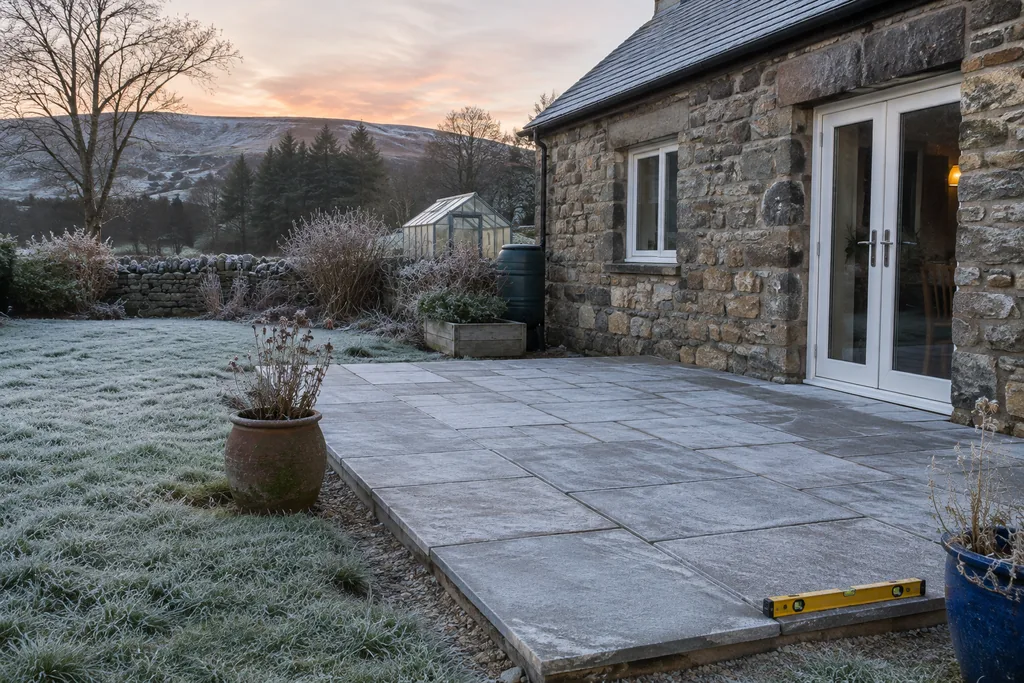
What frost actually does
People say frost cracks paving. Usually it does not, directly. The problem is water. Water gets into a joint, a pore or a hollow under a slab. When it freezes it expands, and it pushes upward and outward on everything round it. A thaw follows, the ice shrinks and a gap opens. Repeat that through a Highland winter and slabs tilt, joints open and edges flake.
Three things feed the cycle: water that cannot drain, a surface that soaks it up and a base that holds it. Break those links and frost has little to work on.
Inverness has an oceanic climate with regular rain and cold spells (Wikipedia, read 24 November 2026). That is the kind of weather that gives ground repeated freeze and thaw, so paving needs to be built to drain, not just to look good on the day.
Heavy rain and where it goes
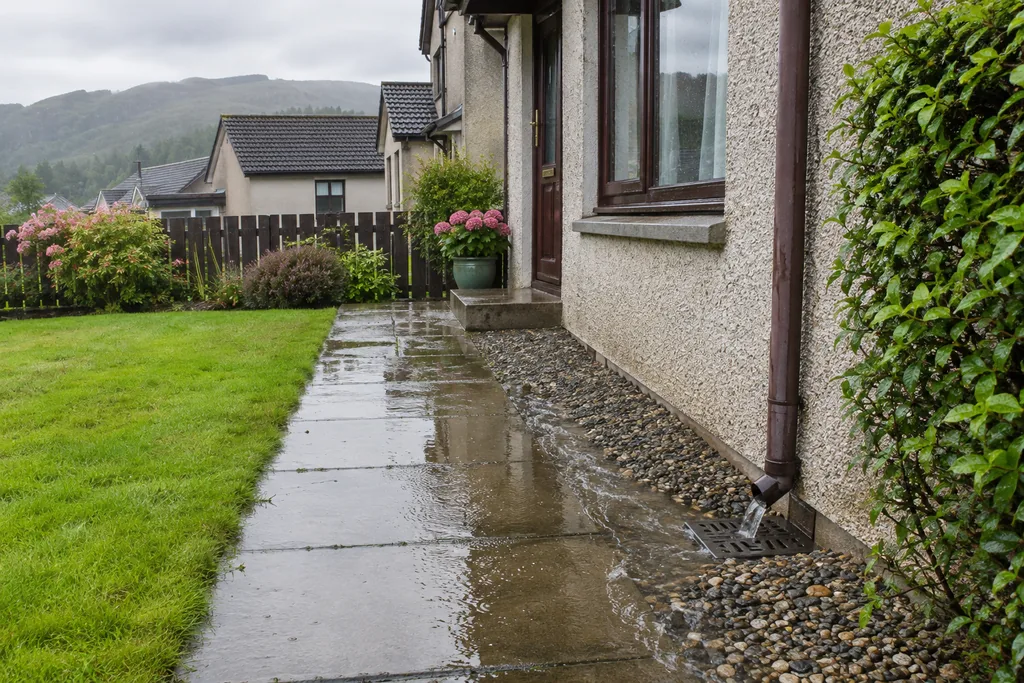
Highland rain often arrives hard, and it keeps coming. A patio or drive collects it and must send it away. If the water lands on a flat surface with nowhere to go, it sits and seeps into the joints.
Ask where the water goes before anything is laid. Good answers include a lawn, a border, a gravel strip, a drain or a soakaway. Bad answers include "towards the house" and "it will find its own way".
The Scottish Government says a hard surface facing a road should be porous or drain to a lawn or border (mygov.scot, updated 18 November 2025). That rule is aimed at flooding, but it sits well with frost protection too.
A base that lets water through
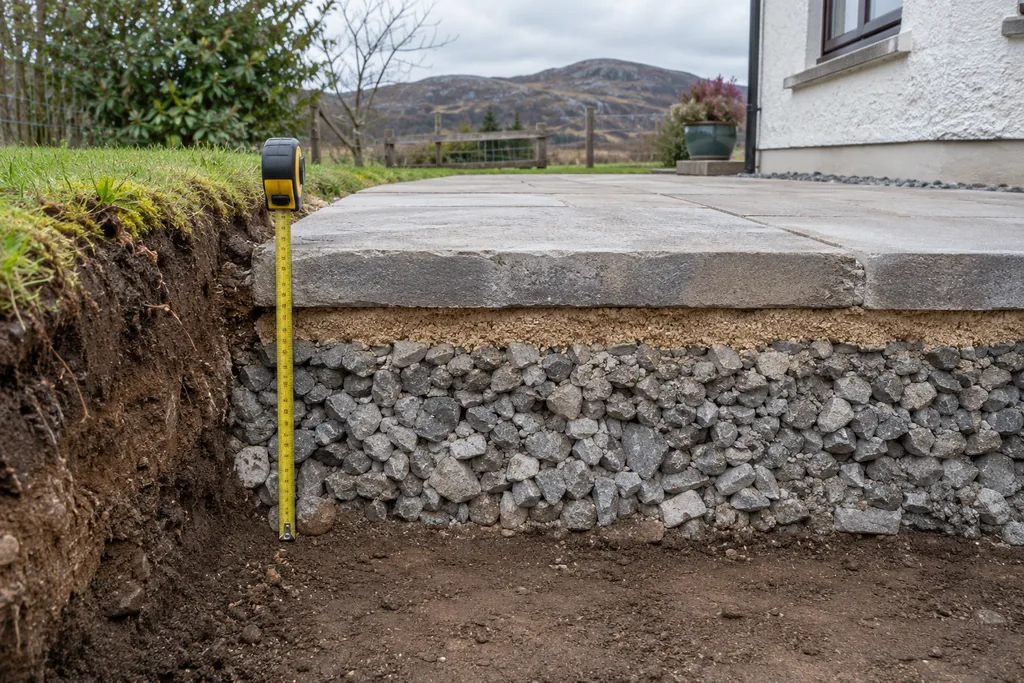
The layer under your paving is the best defence. We use clean crushed stone, not material full of fine dust, because it has gaps that let water drain down and out. It is compacted in thin layers, so it forms a firm, even bed.
How deep? That depends on the ground and the load. A path needs less than a patio. A patio needs less than a drive. Soft or clay ground needs more than firm, free-draining ground. We judge it on site.
- Fine soil in the base. Soil clogs the gaps, and the base holds water.
- Compacting in one thick layer. The bottom stays loose, and later settles.
If water cannot pass through the base, it has to be led away at the sides. A drain or gravel strip at the edge does that.
Falls, gutters and downpipes
A fall is a slight slope, enough for water to move without making the surface feel tilted. We usually set it to carry rain away from the house walls.
Three details are easy to miss.
- Direction. Away from the house, away from your neighbour and towards a place that can take it.
- Downpipes. If a downpipe empties onto paving, it sends a lot of water over one spot. It needs its own pipe or soakaway.
- Damp-proof course. Keep paving well below it. On harled walls, keep it below the bottom edge of the harl, so splashing does not stain or soak it.
Choosing slabs and blocks that cope
Ask the supplier two questions: is it rated for frost, and how well does it grip when wet?
- Porcelain is dense and takes in almost no water. Check the outdoor slip rating. See porcelain paving.
- Sandstone is natural and porous. Pick a type sold for outdoor paving. See sandstone paving.
- Concrete slabs and blocks vary. Pay for a frost-resistant make, and ask what it is.
- Block paving can have permeable joints. See block paving.
De-icing salt can damage some natural stone. Use grit sparingly, and ask your supplier.
Laying in cold weather
Cold affects the work itself.
- A frozen base cannot be compacted. It looks hard and then settles when it thaws.
- Mortar and joint fillers need warmth to set. In a hard frost they may not.
- Wet slabs on a frosty bed can slip, and an unset joint can wash out in rain.
A reputable contractor waits rather than risk it. The weather in the Highlands can change in a day, so a delay is common. Ask what your contractor does when the forecast turns.
If a job has to wait until spring, that is not wasted time. It is the cheapest insurance against a patio that lifts.
Sloping and rural plots
On a slope, water runs faster and carries more. A plot above a road, or a croft with a field behind, may get run-off from higher ground. We look at that before we plan the fall. A drain or gravel strip across the top can catch it before it reaches the paving.
Rural plots often have long tracks and no mains drainage. Soakaways, field drains and septic tanks may be near the patio. Tell us what lies under the ground before we dig. Highland Council says conservation areas have extra planning rules, and that you may need permission before altering a building's exterior (council page, last modified 22 July 2025). If your house is in or near one, ask the council.
To see how a patio is built, read about patios in Inverness.
Questions
Will frost crack my patio?
It can lift or tilt it if water gets under it. A free-draining base, a fall and a frost-rated surface prevent that.
Is it worth laying paving in winter?
Sometimes. In a hard frost, it is better to wait. A good contractor will say so.
Should I seal my paving?
It depends on the material. Ask your supplier for advice for your product.
Can a patio have too much fall?
Yes. Too much fall makes a table tilt and a surface feel awkward. A slight fall is enough.
Do I need a drain?
Not always. Many patios drain to a lawn or border. Where the ground is wet or the plot slopes towards the house, a drain is wise.