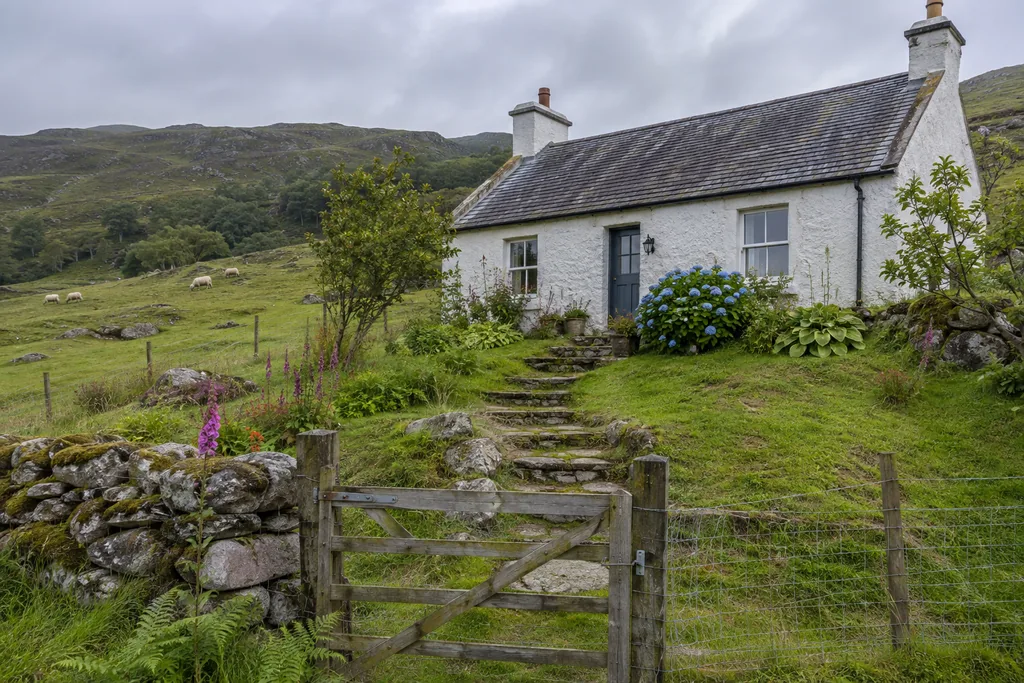
Why Highland plots are awkward
Plenty of Highland homes were never built on a neat flat square. A house may sit on a shelf cut into a hillside, at the end of a half-mile track, beside a burn or in the corner of a field. The garden falls away, or it climbs, or it does both on different sides.
None of that makes paving impossible. It does make the first visit more important. On a flat suburban plot most jobs follow the same pattern. On a hillside croft or a village cottage with a back lane, the plan comes from the ground, the water and the road in, and the slabs are chosen after.
If you are weighing up a patio, a path or a drive on a plot like that, this guide covers the questions that decide it.
Reading the slope
Stand where the paving will go and look at three things.
- Which way does the ground fall? Away from the house is kind. Towards it is harder, because rain from higher ground heads for your wall.
- How steep is it? A gentle slope can be paved as it lies, with a slight fall for water. A steep one needs levelling or steps.
- Where does the water come from? A field, a track or a road above the plot can send a good deal of run-off down onto your garden in heavy rain.
A slope facing the house usually needs a drain or a gravel strip at the foot, to catch the water before it reaches the walls. Harled walls stain and soak if rain splashes onto them, so the paving should finish below the bottom of the harl and below the damp-proof course.
Steps, platforms and held edges
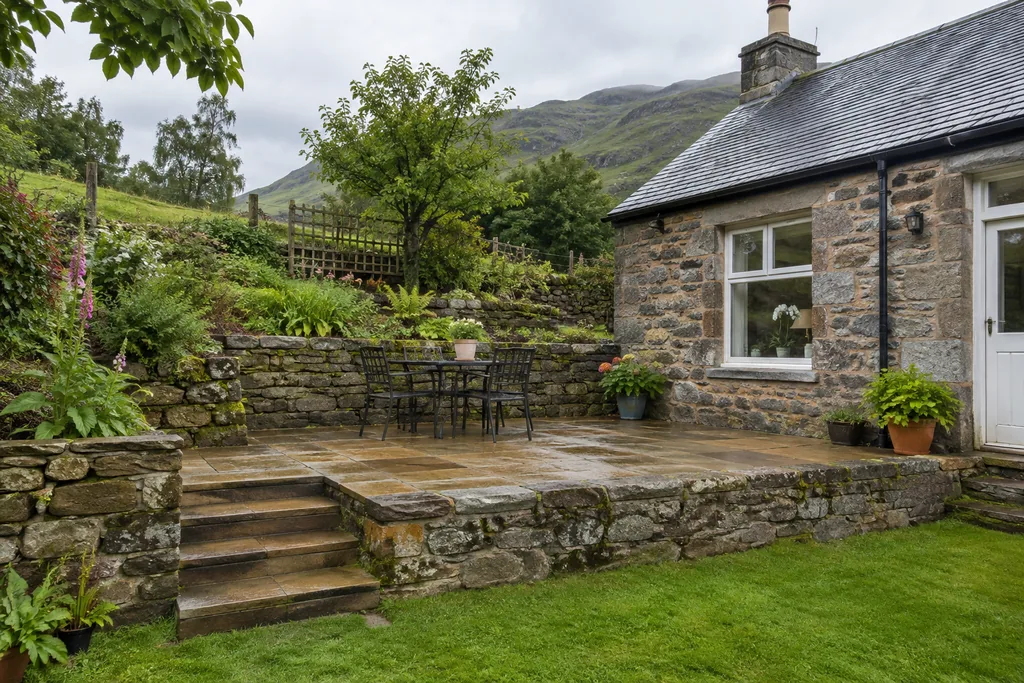
There are three ways to deal with a steep garden, and many plots use two of them.
- Pave it as it lies. This works for gentle slopes, on slabs or blocks laid to a steady fall. Choose a surface with grip.
- Cut a platform. The bank is dug back to a level area, and the edge is held with a firm kerb or a wall. The result is a patio that does not tilt the table.
- Add steps. Short flights with a level landing between runs are far safer in an icy week than one long climb.
Whatever the plan, the base on a slope wants to creep downhill. A firm edge, a thick compacted stone base and no soft spots stop it. If the platform needs a retaining wall, that is a separate job with its own rules.
A handrail needs a solid fixing. Plan its position before the surface goes down.
Access, tracks and lorries
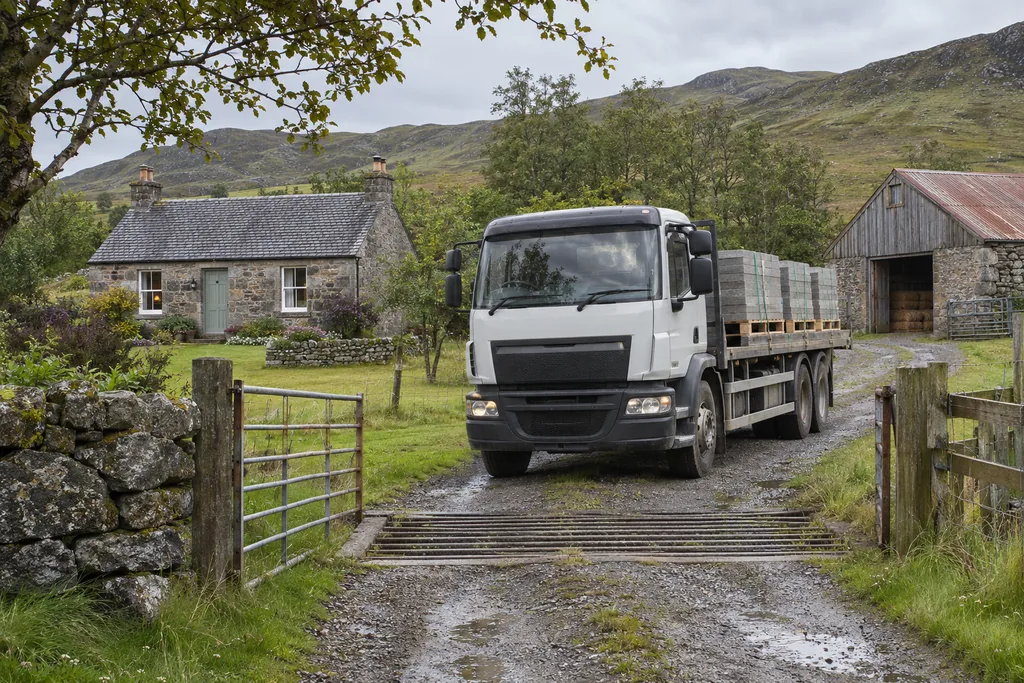
Paving is heavy. A single patio can need several tonnes of stone and slab. All of it has to reach the plot.
- How wide is the track, and are there gateposts, bends or overhanging trees?
- Is there a cattle grid, a weight limit or a soft verge?
- Is there a place for a lorry to turn, or will it have to reverse a long way?
- Can a mini-digger get through the gate and round the side of the house?
If a lorry cannot come in, the materials stop at the road and are carried or barrowed the rest of the way. That adds labour and time, and it appears in a fair quote. Better to hear it on the first call than discover it on the day.
Neighbours matter on shared tracks. If you share the road, tell them when deliveries and diggers are coming.
Drainage with no mains
Many rural homes have a septic tank, a soakaway or a field drain. Paving over a drain cover, or laying heavy stone over a shallow pipe, causes trouble later.
- Find out where your tank, soakaway and pipes run.
- Mark any covers that must stay reachable.
- Ask where rain from the new paving will go. A lawn or border can often take it. On wet ground, a gravel strip or soakaway may be needed.
The Scottish Government says a hard surface between a house and a road should be porous, or drain to a lawn or border (mygov.scot, updated 18 November 2025). On a rural plot, the same thinking helps with run-off from the whole property.
Distance and planning the days
Highland jobs often mean a long drive for the crew. A day that loses an hour each way to the road is a shorter working day, and short winter days are shorter still. That is real cost, and a good contractor says how they treat it.
Weather matters more the further you are from town. A frost, a snow fall or a washed-out track can stop a day. Allow some give in the dates. Our guide to laying paving in frost and rain explains when work waits.
If the track is part of the job, for instance replacing a worn gravel strip with blocks, see replacing a gravel drive.
Highland Council says that if you live in a conservation area you may need permission before altering the outside of a building (council page, last modified 22 July 2025). Some rural settlements have one. Ask the council if you are unsure. A crossing from a public road onto your land needs a road opening permit from the council's roads team (council page, last modified 30 April 2026).
What to tell us on the first call
A few lines save a lot of time.
- Your postcode and the road name
- The width of the track and any gate, grid or weight limit
- How the ground slopes, and which way water runs
- What is there now: lawn, gravel, old slabs or concrete
- Any septic tank, soakaway or field drain you know of
- What you want: a patio, a path, steps or a drive
With that we can say what we would look at. To see how the work runs from there, read about how a paving job runs.
Questions
Can you pave a really steep garden?
Often, with a platform, steps or both. Very steep ground may need a retaining wall as a separate job.
Will you come out to a remote house?
Ring and tell us where you are.
What if a lorry cannot get in?
Materials can be carried from the road, though it adds time. Tell us early.
Do I need permission to pave in the countryside?
Often not for a garden surface, but a listed house, a conservation area or a new road crossing changes that. Check with Highland Council.
Does a sloping plot cost more?
It can, because of extra digging, edging, steps and drainage.