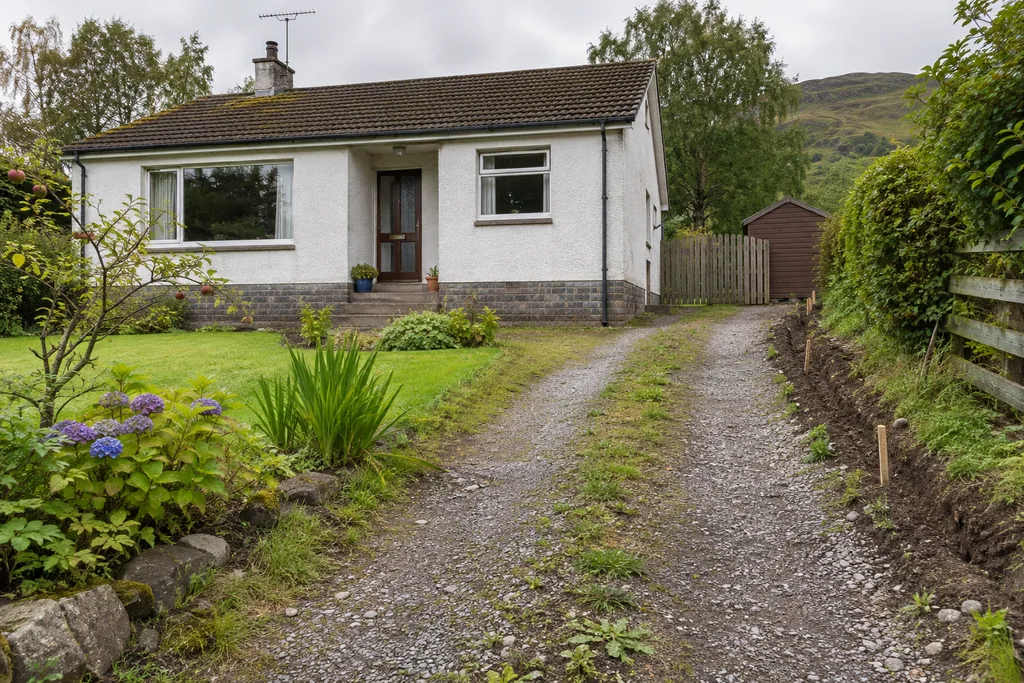
Why gravel gives up
Gravel looks fine in its first year. Then the drive starts to change. Wheels push stones sideways into two tracks. Rain finds the low points and carries fine material down the slope. Snow clearing drags stones onto the lawn or the road, and the shovel catches every lump. Weeds root in the damp gaps, and cats like it.
Highland gardens make all of that worse. Frost heaves the ground. Rain falls hard and often. A drive on a slope loses its top layer to run-off every winter. And many homes here sit a long way from the nearest builders' merchant, so topping up is an errand rather than a habit.
People ask for paving when the yearly top-up stops being worth it. That is a fair point to switch at.
What comes out
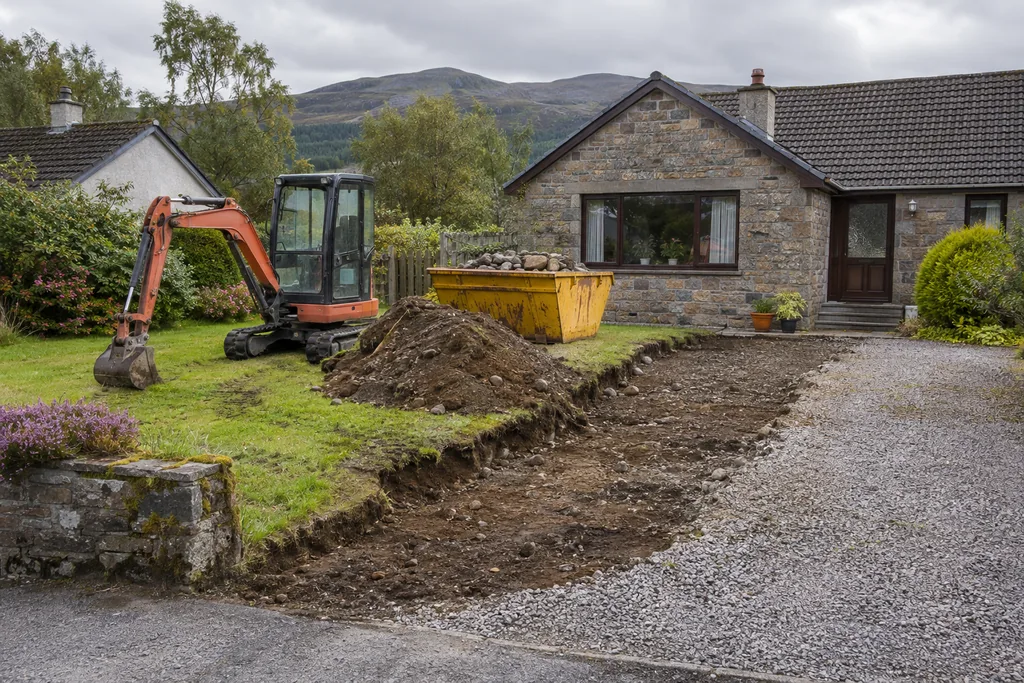
Block paving cannot go over gravel. Gravel moves, and soil under it holds water. A new surface laid on top would sink in patches within a couple of winters.
So the old drive comes out. We dig down far enough to remove the gravel, any weed membrane and the soft soil beneath. How deep depends on the ground. On firm, well-draining ground it is shallower. On clay or wet ground it goes further.
Two practical points matter before the digger arrives.
- Where the spoil goes. A drive generates a lot of it. A skip, a grab lorry or a spot to spread it all need to be planned.
- Where your car goes. The drive is out of use while the work is under way. Plan somewhere to park, and tell any neighbours you share a track with.
What goes in
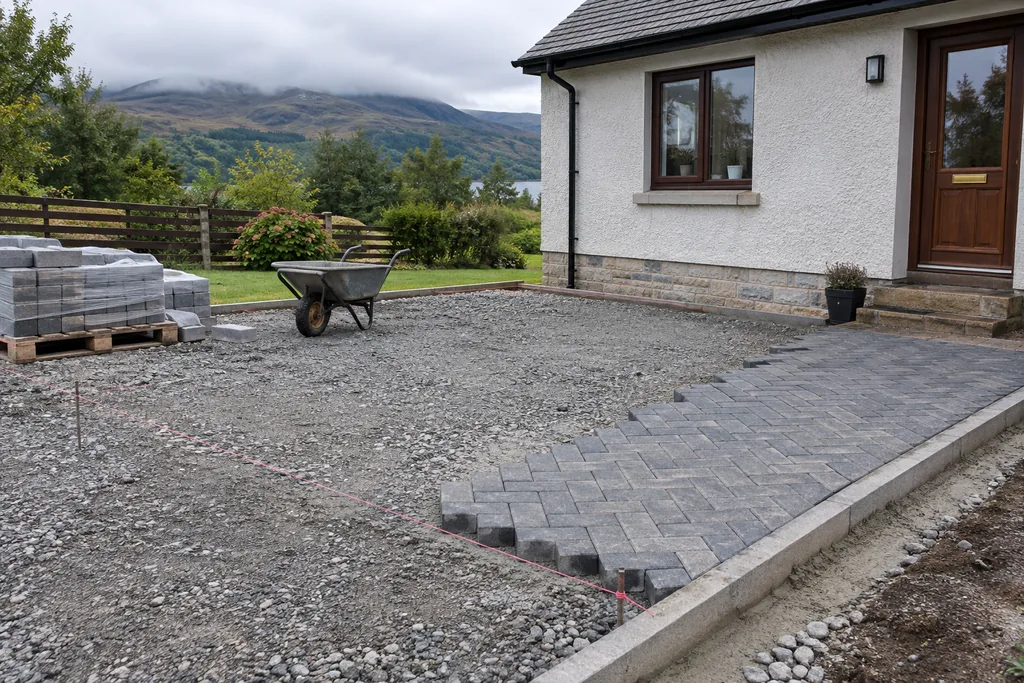
A block drive is built in layers.
- Stone base. Clean crushed stone goes down and is compacted in thin lifts. This layer carries the car and lets water drain away, which matters for frost.
- Laying course. A thin bed of sharp sand or grit levels the surface and sets the fall.
- Blocks. They are laid in a pattern, cut to fit at the edges and pressed down with a plate.
- Jointing. Sand is swept into the gaps, and the plate goes over again.
The base is the biggest decision. A drive for one small car is not the same as a drive for a van or a motorhome. Say what will park on it, and we will build the base to suit.
Blocks come in several shapes, sizes and colours. Mid greys are common because they hide mud and leaf stains. A darker border marks the edge. Herringbone resists the pushing and turning of wheels better than a plain stretcher pattern, so it is a common pick for drives. Our paving styles page goes into the options.
The edge, the kerb and the rain
Three details separate a drive that lasts from one that spreads.
Edging. Blocks need something firm at the sides. Without it they drift outward under the weight of tyres. Edging is set in concrete before the blocks go down.
The kerb. If the drive crosses a pavement, the kerb has to be lowered. A dropped kerb also makes the pavement a vehicle crossing, so the surface there matters.
The rain. Water should not run towards the house, and it should not run across the pavement either. The Scottish Government says a hard surface between the house and a road should be porous or drain to a lawn or border inside your boundary (mygov.scot, updated 18 November 2025). Permeable blocks and a drainage strip can meet that need.
Timing and the weather
In the Highlands, the best time for laying is a dry spell in spring or summer or early autumn. That is not a promise, because rain can arrive in any week. Winter work is possible but patchy.
Frost matters in two ways. A frozen base cannot be compacted properly. And the sand beds and joint fillers may not set in the cold. Good contractors will say that out loud and wait rather than push on. Read our guide to laying paving in frost and rain for more.
Distance counts too. If you live well outside Inverness, ask how the travel is handled in the quote.
What the council says
Highland Council's roads team lists a road opening permit for minor works on a public road or footway, with installing a dropped kerb as an example, and asks applicants to confirm the council maintains the road (council page, last modified 30 April 2026). The page does not give fees or timings, so ask the council what applies to you.
Planning is a separate question. The Scottish Government says a hard surface is usually permitted development, but not between the house and a road in some cases, and not in a conservation area or near a listed building (mygov.scot, updated 18 November 2025). Highland Council lists thirty conservation areas, including several in Inverness (Highland Historic Environment Record, read 24 November 2026).
A dropped kerb that serves a drive can be parked at, but you must not park on the pavement itself (Highland Council pavement parking page, last modified 20 August 2025).
Always check with Highland Council.
Questions to ask a contractor
- How deep is the dig, and what happens to the old gravel and soil?
- What is the base made of, and how thick is it?
- How is the edge held?
- Where will the rain go?
- Who applies for the council permit?
- What happens if the weather turns?
A good answer is short and specific. A vague one is a reason to ask again.
If you want help with your own drive, see how a paving job runs or ring.
Questions
Can new blocks go straight over old gravel?
No. Gravel and soft soil have to be removed, or the blocks will sink.
Is block paving better than tarmac or concrete?
It is different. Blocks can be lifted for repairs and let rain through if permeable. Ask us about block paving. We do not lay tarmac.
Do weeds come up between the new blocks?
Some seeds blow in and sprout. A good jointing sand and occasional sweeping keep it down.
How long will the drive be out of use?
It depends on size and weather. We would give an estimate after seeing the plot.
Do I need permission to replace gravel?
Often not, but a conservation area, a listed house or a new crossing over the pavement changes things. Check with Highland Council.